Synonyms of revisionist, such as reformer, reinterpreter, and modernizer, describe people who challenge established ideas, narratives, or interpretations. For example, a revisionist historian may reinterpret past events based on new evidence or perspectives.
Using the right synonym for revisionist helps you convey tone and context — whether you’re writing about history, politics, or academic debates. Each term highlights a slightly different approach, from reforming ideas to challenging tradition or modernizing interpretations.
If you’re writing about critical thinking, historical analysis, or ideological shifts, choosing precise synonyms for revisionist adds depth, clarity, and authority to your content. In this guide, we’ll explore alternatives, their meanings, and how to use them naturally.
What Does Revisionist Mean?
A revisionist is someone who reexamines and challenges established beliefs, interpretations, or historical accounts. The word comes from revise, meaning to review or alter, highlighting the focus on rethinking accepted ideas.
Revisionists are often associated with:
- Reinterpreting historical events or narratives
- Challenging traditional or mainstream perspectives
- Advocating for reforms or updates in thought
- Offering new evidence or modern viewpoints
It’s not just about disagreement — a revisionist represents careful analysis, critical thinking, and the willingness to reconsider assumptions to provide a more accurate or nuanced understanding.
30 Synonyms & Related Words for Synonyms of Revisionist
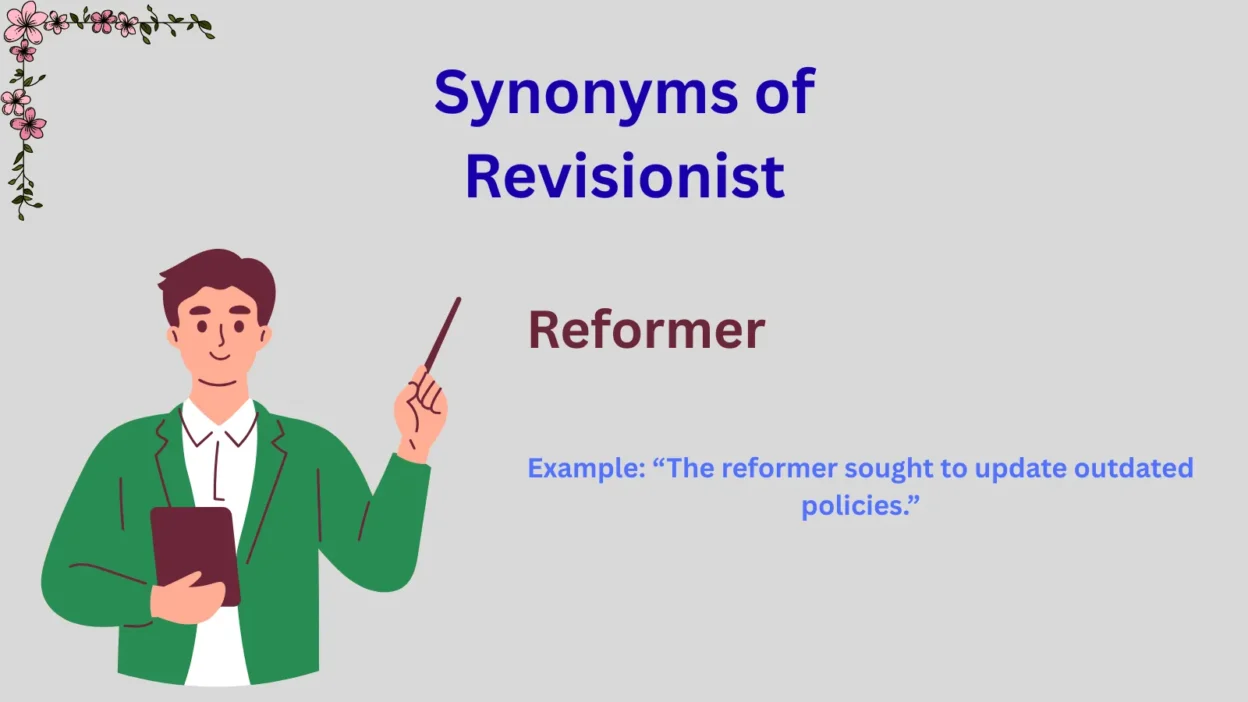
1. Reformer
Description: Someone who advocates for changes to improve systems or ideas.
Example: “The reformer sought to update outdated policies.”
Usage: Positive or neutral; emphasizes constructive change.
2. Modernizer
Description: Person updating traditional ideas or practices.
Example: “The modernizer introduced new teaching methods.”
Usage: Neutral; emphasizes progress rather than challenge.
3. Reinterpreter
Description: One who offers a new understanding or explanation.
Example: “The historian acted as a reinterpreter of ancient texts.”
Usage: Neutral; useful in academic or literary contexts.
4. Revisionary
Description: Related to or advocating revision of established ideas.
Example: “His revisionary approach to history sparked debate.”
Usage: Formal; emphasizes the process of revision.
5. Reviser
Description: A Person who edits or revises theories, policies, or documents.
Example: “The reviser updated the policy manual for clarity.”
Usage: Neutral; practical or professional tone.
6. Re-evaluator
Description: Someone who reassesses or examines previously accepted views.
Example: “The committee acted as a re-evaluator of traditional practices.”
Usage: Neutral; emphasizes analysis and reconsideration.
7. Critic
Description: Someone who evaluates and challenges existing ideas.
Example: “The critic questioned the established economic model.”
Usage: Neutral to negative; depends on tone and context.
8. Skeptic
Description: A Person who doubts or questions conventional beliefs.
Example: “As a skeptic, she challenged the textbook narrative.”
Usage: Neutral; emphasizes doubt rather than formal revision.
9. Iconoclast
Description: Someone who attacks or rejects established beliefs or traditions.
Example: “The iconoclast opposed long-held social norms.”
Usage: Strong, often literary; emphasizes radical challenge.
10. Challenger
Description: A Person who contests established ideas or authority.
Example: “The challenger questioned the prevailing political doctrine.”
Usage: Neutral to slightly confrontational; suitable in debates.
11. Reconsiderer
Description: Someone who reexamines ideas or decisions.
Example: “The reconsiderer proposed new interpretations of the treaty.”
Usage: Neutral; emphasizes reflection and careful review.
12. Heretic
Description: A Person who holds opinions contrary to established beliefs.
Example: “He was labeled a heretic for his unorthodox views.”
Usage: Strong, often negative; historical or religious context.
13. Reassessor
Description: Someone who evaluates and reinterprets accepted knowledge.
Example: “The reassessor brought new insights to historical analysis.”
Usage: Neutral; formal or academic tone.
14. Innovator
Description: One who introduces new methods or ideas.
Example: “The innovator revolutionized the field of education.”
Usage: Positive; emphasizes creativity and progress.
15. Reformist
Description: Advocate of gradual improvement or reform.
Example: “The reformist argued for changes to outdated laws.”
Usage: Positive or neutral; political or social context.
16. Rewriter
Description: A Person who rewrites or revises content or ideas.
Example: “The rewriter updated the textbook with current data.”
Usage: Neutral; literal or metaphorical usage.
17. Reframer
Description: Someone who offers a new perspective or frame.
Example: “The reframer changed the narrative around the policy.”
Usage: Neutral; emphasizes perspective rather than criticism.
18. Deconstructor
Description: One who breaks down ideas to critique or reinterpret them.
Example: “The philosopher acted as a deconstructor of traditional morality.”
Usage: Academic or literary; neutral to critical tone.
19. Reassessor
Description: A Person who reviews and judges established knowledge anew.
Example: “The reassessor analyzed the historical events with fresh insight.”
Usage: Neutral; formal or scholarly contexts.
20. Questioner
Description: Someone who asks critical questions about established norms.
Example: “The questioner challenged assumptions in the debate.”
Usage: Neutral; suitable for educational, casual, or formal contexts.
21. Doubter
Description: A Person who is hesitant to accept conventional views.
Example: “The doubter remained unconvinced by mainstream theories.”
Usage: Neutral; emphasizes caution or skepticism.
22. Re-evaluator
Description: Individual reassessing previously accepted interpretations.
Example: “The re-evaluator introduced new angles in historical research.”
Usage: Neutral; often academic or professional.
23. Historical reviser
Description: Someone who challenges traditional historical accounts.
Example: “The historical reviser brought new perspectives to ancient events.”
Usage: Academic; emphasizes history specifically.
24. Revisionist thinker
Description: An Intellectual who revises established concepts or theories.
Example: “The revisionist thinker reshaped philosophical discourse.”
Usage: Neutral to positive; formal writing.
25. Reframing expert
Description: A Person who provides new frameworks or interpretations.
Example: “The reframing expert offered alternative strategies for the analysis.”
Usage: Professional, neutral; emphasizes perspective.
26. Radical reinterpreter
Description: One who challenges orthodox views boldly.
Example: “The radical reinterpreter questioned every assumption of the doctrine.”
Usage: Strong, literary or political; conveys confrontation.
27. Transformist
Description: Someone advocating transformative reinterpretation.
Example: “The transformist proposed sweeping changes to traditional teaching.”
Usage: Positive; emphasizes constructive transformation.
28. Re-examiner
Description: A Person who carefully examines accepted ideas anew.
Example: “The re-examiner provided evidence to challenge old theories.”
Usage: Neutral; academic or analytical context.
29. Dissenter
Description: An Individual who disagrees with established beliefs or norms.
Example: “The dissenter spoke out against the prevailing policies.”
Usage: Neutral to slightly confrontational; political or social context.
30. Nonconformist
Description: A Person who does not follow prevailing conventions or standards.
Example: “The nonconformist challenged mainstream thought at every turn.”
Usage: Neutral to positive; emphasizes individuality and independent thinking.
How to Choose the Right Synonym
When selecting a synonym for revisionist, consider tone, audience, and context:
- Academic/Neutral: Reinterpreter, reassessor, re-evaluator, re-examiner, historical reviser.
- Constructive/Positive: Reformer, modernizer, innovator, reformist, transformist.
- Critical/Challenging: Iconoclast, dissenter, radical reinterpreter, heretic.
- Casual/Accessible: Questioner, doubter, nonconformist, challenger.
The context determines whether the term is neutral, complimentary, or critical, and cultural or historical sensitivity may also influence tone, especially in political or religious discussions.
Conclusion :
Exploring synonyms of revisionist helps you describe people who challenge established ideas, reinterpret history, or advocate for reform with precision. Words like reformer, reinterpreter, and modernizer each highlight a different approach — from revising traditions to offering new perspectives.
Using the right synonym allows you to convey clarity, authority, and nuance in your writing. These alternatives make discussions about history, politics, or ideological shifts more accurate, engaging, and thought-provoking for your readers.