Synonyms of small, such as smol, miniature, tiny, and modest, describe something of limited size, quantity, or importance. For example, “miniature” highlights a scaled-down version, while “modest” can suggest simplicity or subtlety. These words capture different shades of size, impact, and perception, helping you describe things more precisely.
If you’re writing about objects, people, or abstract ideas, choosing the right small synonym allows you to communicate scale, nuance, and tone effectively.
These other words for small not only make your writing more descriptive but also help convey subtle differences in meaning. From everyday descriptions to creative writing, the language of smallness helps you express size, importance, and delicacy in precise ways.
What Does Small Mean?
Small refers to something limited in size, amount, or significance. It often involves:
- Tiny or miniature dimensions
- Modest or unassuming qualities
- Limited quantity or scope
- Subtle or understated presence
It’s not just about being little—it’s about scale, subtlety, and proportion. Think of small as a word that helps describe size, significance, and detail with precision.
Synonyms & Related Words for Small (And When to Use Them)
1. Tiny
Meaning: Extremely small, often conveying delicacy or cuteness.
Example: The kitten was so tiny it could fit in the palm of my hand.
Usage Tip: Use tiny when emphasizing extreme smallness, often in informal or affectionate contexts.
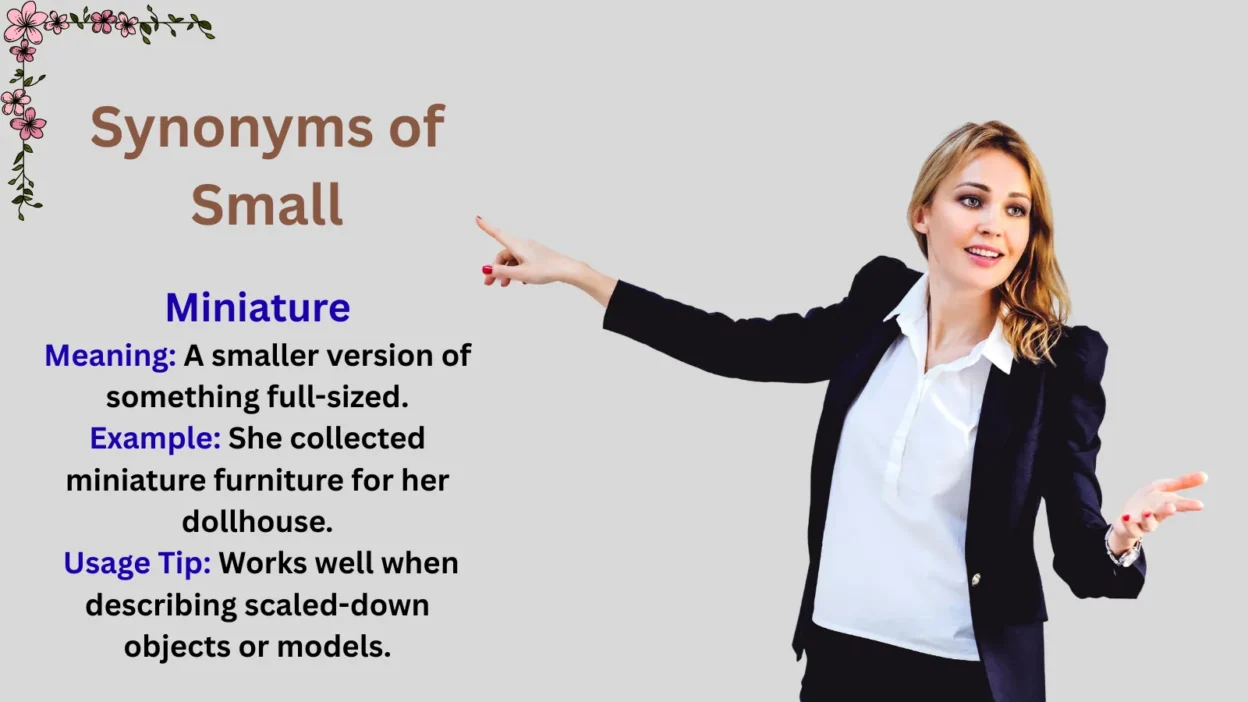
2. Miniature
Meaning: A smaller version of something full-sized.
Example: She collected miniature furniture for her dollhouse.
Usage Tip: Works well when describing scaled-down objects or models.
3. Little
Meaning: Small in size, amount, or degree; can also imply endearment.
Example: He gave her a little gift for her birthday.
Usage Tip: Very versatile—appropriate for both formal and informal contexts; often conveys warmth or affection.
4. Petite
Meaning: Small and dainty, often referring to a person or object.
Example: She wore a petite dress that perfectly fit her figure.
Usage Tip: Often used for women’s clothing or delicate objects, with a slightly elegant tone.
5. Minute
Meaning: Extremely small; emphasizes precision or fine detail.
Example: There was a minute crack in the vase.
Usage Tip: Formal or academic contexts work best; not typically used in casual conversation.
6. Compact
Meaning: Small, but well-arranged and efficient.
Example: The apartment was compact but cozy.
Usage Tip: Ideal for describing functional spaces or objects that maximize smallness positively.
7. Slight
Meaning: Small in degree or amount.
Example: There was a slight improvement in his health.
Usage Tip: Often used in formal contexts or when describing abstract quantities like differences or changes.
8. Modest
Meaning: Small or moderate in size, quantity, or scope; also implies humility.
Example: They lived in a modest home near the countryside.
Usage Tip: Good for emphasizing restraint or understatement; works well in polite or neutral contexts.
9. Diminutive
Meaning: Very small, often endearingly or unusually; also refers to shortened names.
Example: He had a diminutive frame that made him appear younger than his age.
Usage Tip: Academic, literary, or descriptive writing benefits most from this term.
10. Mini
Meaning: Shortened form of “miniature”; small version of something.
Example: She bought a mini backpack for her trip.
Usage Tip: Informal and modern; often used in marketing or casual speech.
11. Puny
Meaning: Small and weak; often conveys inferiority.
Example: The puppy looked puny compared to its littermates.
Usage Tip: Use carefully, as it can sound negative or insulting.
12. Slightest
Meaning: Smallest in degree; often used in hypothetical or conditional phrases.
Example: He didn’t show the slightest interest in the project.
Usage Tip: Ideal for emphasizing minimal degrees or subtlety.
13. Minor
Meaning: Small in importance or significance.
Example: They fixed a minor error in the report.
Usage Tip: Best for formal or professional contexts rather than physical size.
14. Insignificant
Meaning: Too small to matter; lacking importance.
Example: His contribution was insignificant compared to hers.
Usage Tip: Emphasizes lack of value or impact rather than physical size.
Chillpuns.com is your new favorite place where every pun is funny enough to share with your best friends!
15. Wee
Meaning: Very small; often playful or affectionate.
Example: The baby had wee fingers and toes.
Usage Tip: Common in British or Irish English; conveys endearment or humor.
16. Short
Meaning: Small in length or height.
Example: He wore a short coat for the summer.
Usage Tip: Focuses on dimensions rather than volume; literal and neutral.
17. Little-bitty
Meaning: Extremely small; informal and colloquial.
Example: Look at that little-bitty frog!
Usage Tip: Playful, informal, and often used with children or in casual speech.
18. Negligible
Meaning: So small that it can be ignored.
Example: The risk of error is negligible.
Usage Tip: Best for technical, statistical, or scientific writing.
19. Toy
Meaning: Small and often not taken seriously; sometimes trivialized.
Example: He had a toy version of the car.
Usage Tip: Use when emphasizing smallness for playful or diminutive effect.
20. Compact-sized
Meaning: Small but efficiently proportioned.
Example: She drove a compact-sized car in the city.
Usage Tip: Suitable for product descriptions; implies practicality.
21. Bitty
Meaning: Very small; informal and endearing.
Example: The bitty mouse ran across the floor.
Usage Tip: Casual and conversational; often conveys cuteness.
22. Minuscule
Meaning: Extremely small; often emphasizes precision or difficulty in noticing.
Example: The details were minuscule, requiring a magnifying glass.
Usage Tip: Formal or descriptive contexts; emphasizes minuteness.
23. Skimpy
Meaning: Smaller than necessary; sometimes insufficient.
Example: He wore a skimpy jacket that didn’t keep him warm.
Usage Tip: Often negative; emphasizes inadequacy.
24. Tiny-scale
Meaning: Very small in scope or size.
Example: They conducted a tiny-scale experiment before the main study.
Usage Tip: Scientific or project contexts; conveys small-scale planning.
25. Dinky
Meaning: Small and unimpressive; informal.
Example: The hotel room was dinky but clean.
Usage Tip: Casual, slightly negative, or humorous tone.
Curious about meanings in text? Explore [https://pickuplin.com] to discover clear explanations behind common and unusual words, phrases, and expressions!
26. Pocket-sized
Meaning: Small enough to fit in a pocket.
Example: He carried a pocket-sized notebook for notes.
Usage Tip: Practical, descriptive; often for portable items.
27. Slight-of-frame
Meaning: Small and delicate in physique.
Example: The athlete was slight of frame but surprisingly strong.
Usage Tip: Descriptive, often literary; conveys subtle physicality.
28. Compact-built
Meaning: Short or small but robustly constructed.
Example: The compact-built dog was agile and strong.
Usage Tip: Useful for animals, vehicles, or objects where smallness does not imply weakness.
29. Minor-scale
Meaning: Small in size or proportion relative to something larger.
Example: They created a minor-scale version of the bridge for testing.
Usage Tip: Technical or project-based writing; conveys reduced scope.
30. Dwarfish
Meaning: Very small, often compared to something larger; can sound archaic or literary.
Example: The dwarfish trees in the garden created a mystical look.
Usage Tip: Literary, descriptive, or imaginative writing; evokes visual imagery.
How to Choose the Right Synonym
- Consider tone: Words like tiny, wee, or bitty are affectionate or playful, while puny, skimpy, or insignificant can carry negative connotations.
- Context matters: Physical size versus abstract quantities require different words. For example, minor or negligible works for abstract concepts, while petite or compact works for objects or people.
- Cultural and emotional nuance: British English may favor wee, while American English often uses tiny or bitty. Literary contexts might prefer diminutive or dwarfish.
- Precision and style: Formal writing benefits from words like minuscule, minute, or slight, whereas casual writing allows for tiny, bitty, or little-bitty.
Conclusion
Synonyms of small, like tiny, miniature, petite, and modest, give you more ways to describe size, scale, and subtlety in your writing. Each synonym adds a slightly different nuance—whether it emphasizes literal size, understated qualities, or delicate impact.
Using the right word helps make your descriptions more precise, vivid, and relatable. If you’re writing creatively, academically, or in everyday contexts, these synonyms allow you to convey scale, importance, and detail effectively.
In the end, small is more than just little—it’s a versatile word that can capture subtlety, proportion, and nuance, and these synonyms give you the tools to express it clearly.